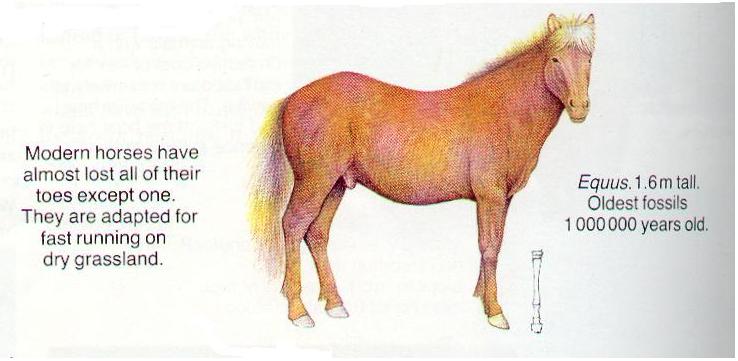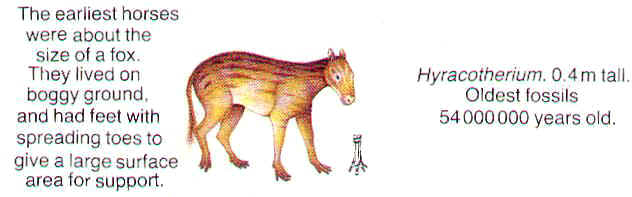
Prehistoric Horses
Scientists have been able to trace the Evolution of the horse back to between 55 and 38 million years ago. The specie has been traced through fossil remains and was originally identified as 'Eohippus' and later known as the 'Hyracotherium'. This creature was about a size of a fox, had four toes on each of its front feet and three on its back feet, fed on leaves. Several species were identified as having appeared in North America and Eurasia during the Eocene period. The Eurasian species died out, but American species developed and between 38 and 24 million years ago was called the 'Mesophippus'.
During the Micocene period (24 to 5 million years ago) the 'Mesophippus' evolved both through the 'Hypohippus' and 'Anachitherium' types It is thought that these types of 'horse' migrated to Eurasia from N. America.
Over time the genus has developed high crowned or incisors teeth, allowing it to graze on grass rather than leaves.
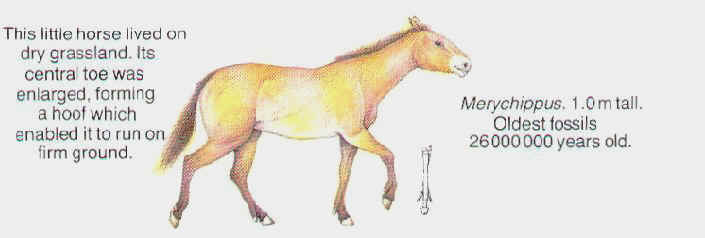
From then until the present day other decendents hace been identified as the 'Hipparion' in the Piocene era and 'Plioppus', which is very similar to the modern form of the horse today-called Equus.